
All articlesPublic-private partnerships
Public Safety Facility Financing Options for Local Officials
Public safety facility development financing options are not interchangeable. A municipality planning a fire station, police station, sheriff's operations facility, or emergency operations center must weigh funding, proj...

Managing Director
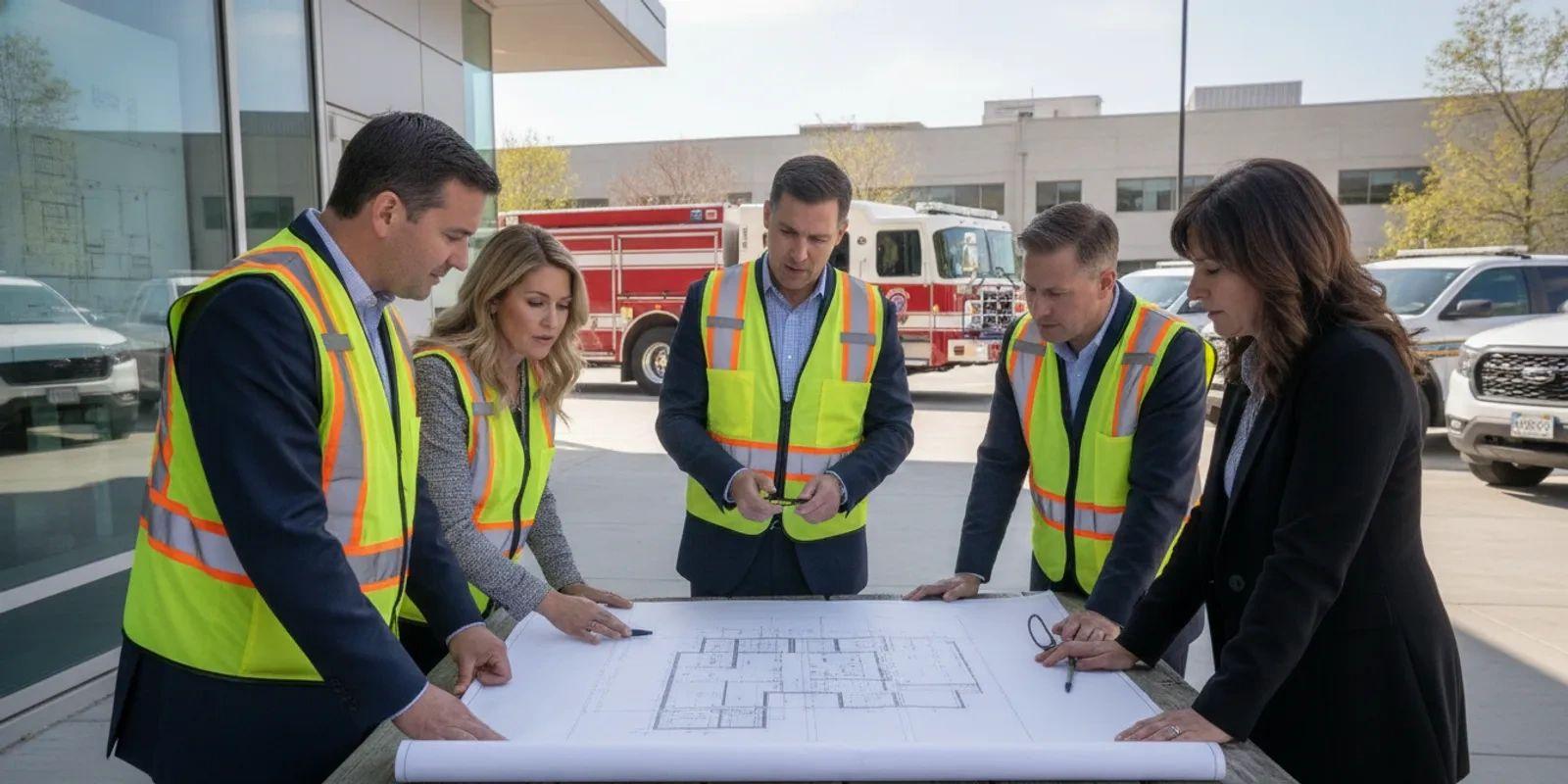
Public safety facility development financing options are not interchangeable. A municipality planning a fire station, police station, sheriff's operations facility, or emergency operations center must weigh funding, project delivery, approvals, lifecycle obligations, and the public owner's retained risks together. The right comparison starts with the facility need and local constraints, not a financing label.
This guide is for local-government officials and public-sector facilities planners at an early or intermediate planning stage. It explains options at a general level. It is not legal, accounting, engineering, or financial advice, and it does not imply that any one structure will suit every jurisdiction. Public procurement requirements, governing-body or voter approvals, accounting treatment, and contract terms must be reviewed for the project and jurisdiction.
What should a financing comparison answer?
A facility project has more than one cost question. Officials need to understand when funds are available, how the project will be delivered, what payments may continue over time, which party carries each responsibility, and what happens at the end of an agreement. A financing source does not by itself answer design, construction, schedule, maintenance, or title questions.
Begin with a written project definition. It should describe the operational need, existing conditions, desired capacity, site assumptions, critical functions, required completion range, and the public budget context. If the scope is uncertain, early estimates can create false confidence. Separate essential requirements from preferences and identify decisions that remain open.
- Need and scope: What service must the facility support, and what spaces and systems are necessary?
- Capital availability: What funds are available now, and what future revenues or payment obligations are feasible?
- Approvals: What procurement, governing-body, voter, state-law, or other review may apply?
- Risk and roles: Who is responsible for site, design, permitting, construction, financing, operations, and maintenance?
- Lifecycle and end state: What will the facility cost to operate and maintain, and what options apply when an agreement ends?
Officials can review the Civic Six Partners overview of public facility services and its public-private partnership FAQs for general context. Those materials do not replace review of an actual proposal or contract.
Which financing and delivery paths might a municipality compare?
Local governments may evaluate municipal bonds, grants, public loans, lease-revenue approaches, or a privately financed public-private partnership (P3), among other possibilities. Availability and suitability depend on law, funding eligibility, credit and budget conditions, approvals, project scale, and market circumstances. These are categories for comparison, not a promise that a particular source is available or that Civic Six issues or administers each one.
Municipal bonds
A bond can provide capital for eligible public projects, subject to the municipality's authority, financing plan, market conditions, and required approvals. Officials should account for issuance and professional costs, repayment sources, timing, and the effect of debt obligations on other priorities. A bond vote or other approval may be required depending on jurisdiction and structure. A successful bond outcome should not be assumed in advance.
Grants and public loans
Grant and public loan programs can support certain projects, but eligibility, application windows, matching requirements, allowable uses, and award timing vary. A grant is not guaranteed funding until awarded, and a loan still creates repayment obligations. Verify program rules directly and consider whether funding timing aligns with design and construction needs.
Lease-revenue and lease-purchase approaches
These labels can describe different legal and financial arrangements. Payment sources, appropriation terms, ownership, renewal rights, and end-of-term outcomes depend on governing documents and applicable law. A lease should not be treated as automatically outside public debt or budget rules. Ask municipal counsel and finance professionals to analyze the specific agreement and accounting standards.
Privately financed P3 delivery
In a P3, a public entity and private parties may allocate financing and delivery responsibilities through a project-specific agreement. Civic Six Partners describes its work as financing, developing, and delivering public facilities, then leasing completed assets to public entities under long-term agreements. The actual division of responsibilities and commercial terms must be established in the agreement. Potentially limited upfront capital does not mean the facility is free or that the public entity avoids paying: contractual lease payments over time cover development, construction, financing, and applicable fees, and cumulative payments can exceed traditional financing.
Some P3 educational material describes a build-lease-transfer (BLT) model. BLT is one possible structure, not the structure of every P3 or every Civic Six project. Do not infer title transfer, maintenance coverage, or risk transfer from the name alone. Review the actual agreement and its end-of-term provisions.
How do options differ in practical terms?
The table is a starting framework, not a ranking. The answers depend on project documents and local rules.
Path to evaluate
Potential funding or payment approach
Questions to resolve
Municipal bonds
Capital raised through public borrowing and repaid from designated public sources
What approvals, issuance costs, repayment sources, and timing apply?
Grants or public loans
Program funding, potentially with eligibility conditions, matching funds, or repayment
Is the project eligible, when can funds be awarded, and what conditions apply?
Lease-revenue or lease-purchase
Payments under a lease or related agreement
How are payments authorized and accounted for, and what are renewal and title terms?
Privately financed P3
Private financing and delivery may be paired with public payments under a long-term contract
Which party carries each risk, what is the full payment schedule, and what happens at term end?
Compare total obligations and responsibilities over the same period. Separate initial capital needs from recurring payments, financing costs, maintenance, utilities, staffing, and major renewal needs. Identify retained public responsibilities, such as oversight, approvals, service delivery, or site obligations, rather than assuming a private partner takes every risk.
What should officials establish before comparing proposals?
Define evaluation conditions before inviting or reviewing proposals. This helps the public team compare like with like and explain decisions to elected officials and residents.
- Confirm the service case. Document why the existing building or capacity is inadequate. Include operational requirements, safety and continuity needs, and the consequences of deferring work.
- Set a scope baseline. Identify the site, spaces, systems, resilience needs, equipment interfaces, and phasing assumptions. Note what remains subject to study.
- Map funding and approvals. Ask finance staff and counsel to identify lawful funding sources, appropriation requirements, procurement rules, and public approvals. Do not assume a delivery model bypasses competition or voter review.
- Use consistent cost periods. Compare capital, financing, and lifecycle costs over a stated period. Make assumptions visible, including escalation, maintenance, major replacements, and residual value where relevant.
- Assign responsibilities explicitly. Create a role matrix for property acquisition, design, permitting, construction, commissioning, operations, maintenance, and performance monitoring.
- Specify end-of-term choices. Determine whether the agreement ends, transfers ownership, or permits negotiated continuation; identify conditions, costs, and asset condition requirements.
For alternative project delivery, a team may examine progressive design-build, design-build, or construction manager as general contractor (CMGC), where permitted and suited to the project. These approaches concern how design and construction are organized; they do not automatically supply financing. A P3 can combine delivery components, but only the agreement defines them. The P3 process overview can provide background before testing a proposed structure against local requirements.
How should a team assess lifecycle cost and risk?
Compare the full public obligation, not only the first-year budget effect. For each option, list payment timing, financing charges, expected maintenance, major equipment replacement, energy and operating costs, and public staff time needed to oversee performance. State which costs are estimates and which are contractually defined. If project scope or term differs across options, explain the difference rather than presenting a misleading comparison.
Risk allocation should be specific and priced. Ask what happens if the site is unsuitable, approvals take longer than expected, construction conditions differ from assumptions, or the facility needs repair. Clarify insurance, change processes, acceptance criteria, remedies, and the public entity's obligations. Avoid claims of fixed cost, guaranteed timing, or complete risk transfer unless supported by the agreement and reviewed for the project.
Maintenance deserves a separate analysis. A long-term arrangement may include some maintenance duties, but responsibility depends on the contract. Define routine work, preventive maintenance, emergency repairs, capital renewals, inspections, reporting, and standards at handback or transfer. The public-owner maintenance guide offers further planning considerations. The public entity should still determine how it will monitor the facility and preserve service continuity.
How can an agency compare payment proposals consistently?
Use a common worksheet and state every assumption. A proposal that appears smaller in its first-year budget may carry payments over a longer period; a capital-funded project may require large expenditures earlier but have a different maintenance and renewal profile. Neither observation decides the question by itself. The purpose of normalization is to show the tradeoffs clearly.
For each option, record:
- the expected date and conditions for capital availability;
- the public payment schedule and its source, including any appropriation assumptions;
- financing, issuance, advisory, development, construction, and other stated fees;
- scope inclusions and exclusions, including site work, equipment interfaces, and commissioning;
- operations, utilities, maintenance, and replacement obligations assigned to each party;
- the assumed agreement term, renewal choices, title, and end-of-term condition;
- the sensitivity of the comparison to schedule changes, escalation, interest assumptions, and scope changes.
Use one comparison period and disclose the basis for any present-value calculation. If specialists use different discount rates or inflation assumptions, show those differences rather than hiding them in a single total. Keep one-time capital cost distinct from recurring operating cost. Include a scenario where major equipment requires replacement earlier than expected, and another where the project schedule shifts and interim space is needed. These scenarios do not predict outcomes; they reveal which assumptions drive the result.
For example, imagine two proposals for a public safety facility with the same room program but different payment timing. Option A would require more capital near construction, with the municipality separately budgeting maintenance. Option B would involve limited upfront capital and contractual payments over time, with some defined maintenance duties assigned by contract. The comparison should not label one cheaper based only on the initial appropriation. Officials need to add fees, future payments, maintenance, retained obligations, and end-of-term choices across a consistent period. If the scopes, risk allocation, or facility condition standards differ, explain those distinctions alongside any totals.
What information should a municipality prepare before a feasibility conversation?
An initial discussion is more useful when the public team has assembled a concise project brief. It need not be a final design. It should distinguish confirmed information from working assumptions so that questions can be prioritized.
- Service case: Which public safety function is affected, what operational deficiency is being addressed, and what happens if the project is deferred?
- Facility program: What spaces, response functions, support areas, systems, security needs, and future capacity are known?
- Site status: Is a site identified, and are access, utilities, environmental conditions, ownership, and acquisition questions understood?
- Schedule drivers: Are there service transitions, expiring leases, funding cycles, seasonal constraints, or other dates that affect planning?
- Budget context: What capital resources, recurring payment capacity, grants under consideration, and approval limits need review?
- Decision pathway: Which departments, governing bodies, residents, finance advisers, and counsel must participate, and when?
- Known constraints: What procurement rules, state-law questions, staffing limits, or continuity requirements must be addressed?
Label each item as confirmed, estimated, or unresolved. Attach existing studies or condition reports if available, but do not treat an old estimate as a current project budget without checking its scope and date. A short list of open questions is often more useful than a long presentation that obscures uncertainty.
For a fire station, for example, the public team might have operational agreement on apparatus bays and response functions but still need to evaluate site access, utility capacity, and temporary continuity during construction. For a police station or emergency operations center, equipment interfaces and uninterrupted operations may shape phasing and commissioning. These examples are prompts for discovery, not assumptions about every municipality or facility.
What questions should an agency ask a potential project partner?
Ask for evidence and clarity that can be evaluated, not broad assurances. A public team can request:
- a description of the proposed financing and delivery structure, including what is and is not included;
- a project schedule with dependencies, approval milestones, and assumptions, without treating a forecast as a guarantee;
- a complete payment schedule and explanation of development, construction, financing, and other fees;
- a draft responsibility matrix and explanation of risks retained by the public owner;
- proposed maintenance, lifecycle renewal, reporting, and end-of-term provisions;
- relevant, attributable project experience stating the entity involved, the team's role, project status, and source;
- disclosure of required public approvals and the professional reviews the municipality should obtain.
Project examples should be described accurately. Civic Six's site presents certain facility narratives as experience of its team; those examples should not be mistaken for proof of a Civic Six-financed contract or a measured company outcome without project-specific substantiation. A municipality can request role, contracting party, dates, scope, and owner references where available, while applying its own procurement and disclosure rules.
When might a P3 feasibility conversation be useful?
A feasibility discussion may help when a public entity has a defined facility need but wants to test whether a particular delivery and financing structure merits further evaluation. It is most useful when the municipality can share initial scope, timing, site status, budget context, known approval constraints, and decision-makers. The purpose is to identify questions and potential fit, not to substitute for procurement, legal review, or a commitment to proceed.
For any potential arrangement, ask whether state law allows the proposed structure and whether the municipality has authority to enter it. Confirm public procurement, governing-body, voter, accounting, and debt-treatment considerations with qualified professionals. Outcomes vary by jurisdiction and contract; no general description establishes a legal or accounting result for a particular project.
The U.S. Government Accountability Office's guide to evaluating public-private partnerships discusses public-sector considerations for assessing these arrangements. See GAO's public-private partnership evaluation guide for an independent framework; it is background material, not jurisdiction-specific legal advice or a substitute for current project analysis.
Frequently asked questions
Does private financing mean a public facility costs the municipality nothing upfront or over time?
No. A structure may potentially limit upfront capital needs, but the public entity has contractual obligations. Lease payments over time cover development, construction, financing, and applicable fees, and cumulative payments can exceed traditional financing. Compare the complete payment schedule and lifecycle responsibilities.
Does a P3 remove the need for public procurement or voter approval?
Not automatically. Procurement rules, voter approvals, and other legal requirements depend on jurisdiction and project structure. Obtain jurisdiction-specific legal and finance review before making a decision.
Does a P3 guarantee a faster schedule or fixed project cost?
No general guarantee follows from the P3 label. Schedule and cost depend on scope, approvals, site conditions, contract terms, and execution. Review assumptions, contingencies, remedies, and responsibility allocation in the proposed agreement.
Does a build-lease-transfer arrangement always transfer ownership?
No. BLT is one educational model, and end-of-term outcomes are agreement-specific. A lease may expire, ownership may transfer, or the parties may negotiate continued service. Confirm title, condition, costs, and options in the governing documents.
Can a municipality know in advance whether lease payments receive a particular debt or accounting treatment?
Not from the label alone. Treatment depends on local standards, the structure, and the agreement. The municipality's finance professionals and counsel should review actual terms.
Request a consultation or call 888-222-1882.
A prepared project brief gives the initial conversation a practical focus: the facility need, scope, site and approval context, funding assumptions, and questions the municipality still needs to resolve.