
All articlesPublic-private partnerships
Build-Lease-Transfer (BLT) P3 Model Explained
Numerous delivery models are available under a public-private partnership (P3). One such model used in public infrastructure is the Build-Lease-and-Transfer (BLT) model.

Managing Director
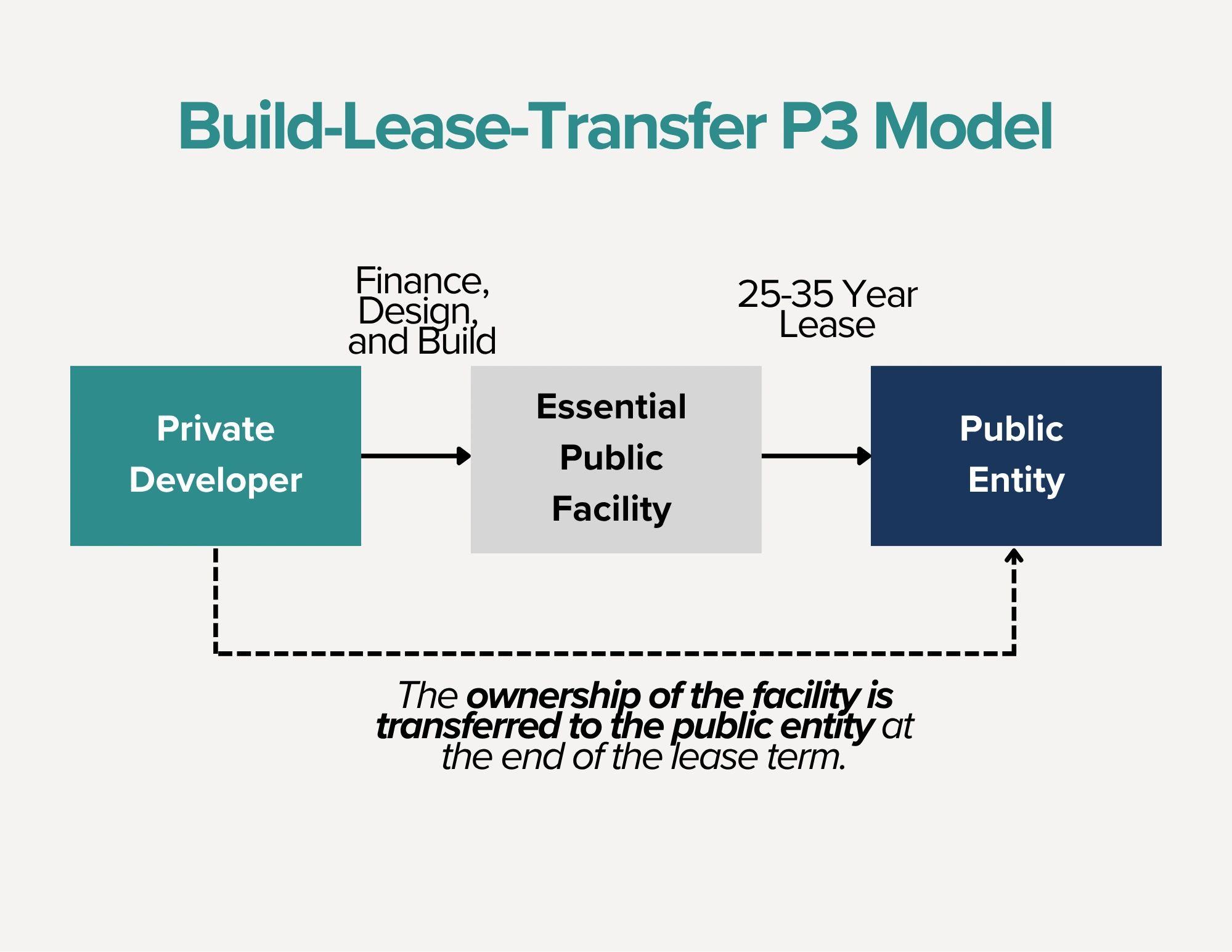
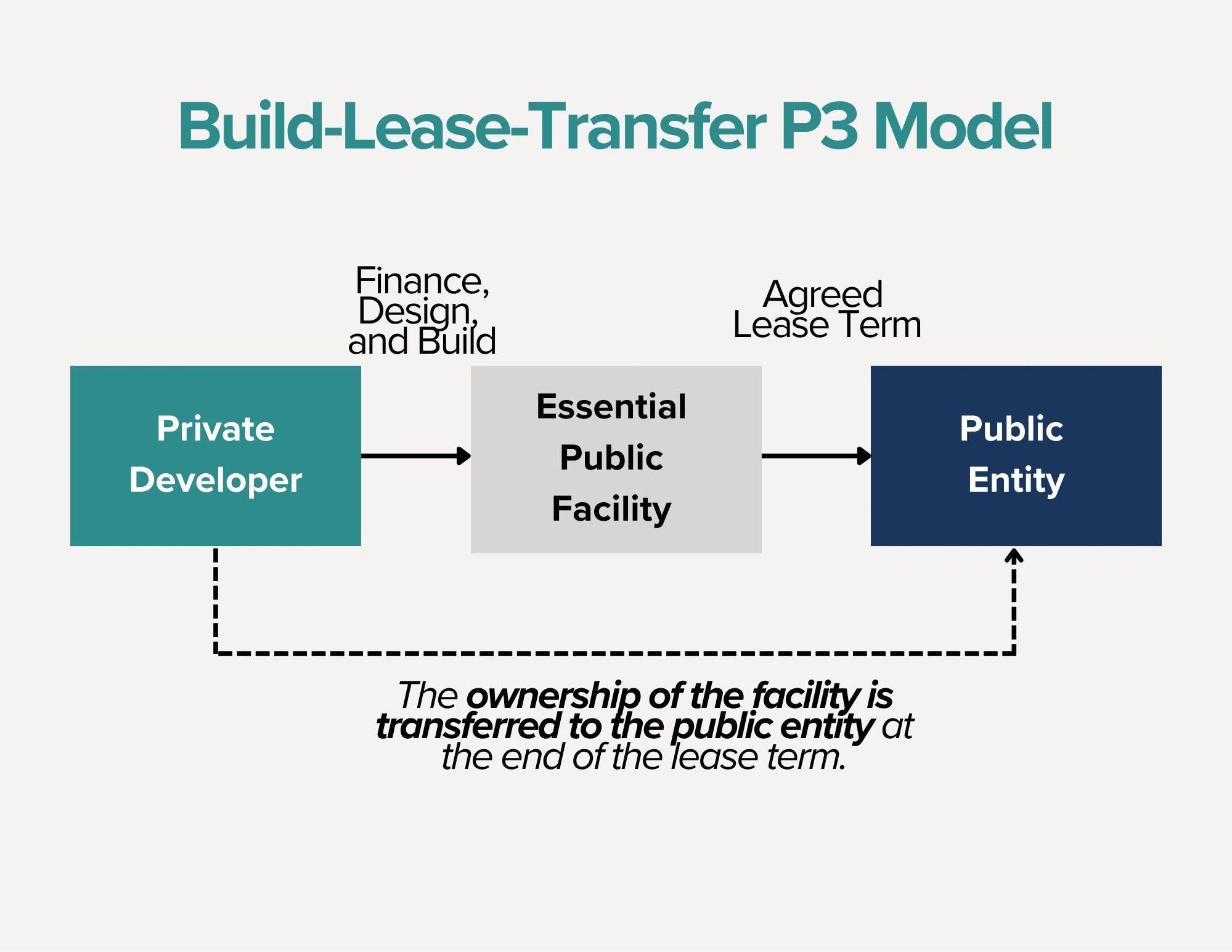
The Build-Lease-Transfer (BLT) P3 Model
Numerous delivery models are available under a public-private partnership (P3). One such model used in public infrastructure is the Build-Lease-and-Transfer (BLT) model.
Definition
Build-Lease-Transfer (BLT) is a public-private partnership model where a private developer finances, designs, and builds an essential public facility, then leases it to the public entity for an agreed term before ownership transfers to the public entity.
Key Takeaways
- Build-Lease-Transfer can provide an alternative way for communities to deliver an essential facility when traditional funding is unavailable, insufficient, constrained by competing priorities, or otherwise does not align with the project's needs.
- Lease payments of the public entity are structured to support the private developer's upfront development and construction costs, financing costs, and applicable fees over the agreed term.
- Maintenance typically stays with the developer during the lease term, while operations typically stay with the public entity, though responsibilities vary by agreement.
- The public entity occupies and uses the facility once completed, while the developer retains ownership during the lease term.
- Ownership transfers to the public entity at the end of the lease term, potentially for nominal consideration.
What is Build-Lease-Transfer (BLT)?
In a BLT arrangement, a private developer finances, designs, and builds an essential public facility for a public entity. Once construction is complete, the public entity begins occupying and using the facility, while ownership remains with the developer for an agreed period under a lease.
During this lease period, the public entity makes rental payments to the developer under the terms of the agreement. These payments are structured to support the developer's upfront costs in the project, including development and construction costs, financing costs, and applicable fees.
At the end of the lease term, ownership of the facility transfers to the public entity in accordance with the terms established in the agreement. This is the "transfer" step that completes the arrangement.
Maintenance responsibility during the lease period typically stays with the developer, while the public entity handles day-to-day operations. The allocation of responsibilities can vary by agreement and may include other operating or maintenance obligations for either party.
A Typical Build-Lease-Transfer (BLT) Structure
- The private developer finances and constructs the essential public facility.
- The public entity occupies and uses the facility upon its completion.
- The public entity makes payments to the developer over the lease term under the agreed structure.
- Operations and maintenance responsibilities are allocated between the parties based on the project agreements.
- At the end of the lease period, ownership transfers to the public entity in accordance with the terms of the agreement.
Benefits
- Risk transfer to the private sector. Design, construction, and financing risk sit with the developer. If costs run over or the schedule slips, that's the developer's exposure, not the public entity's.
- No upfront capital outlay. The public entity does not need to fund the full capital cost of construction at the outset, allowing it to preserve available capital for other priorities.
- Alternative to traditional public financing. A BLT structure provides another way to deliver an essential facility when traditional funding is unavailable, insufficient, constrained by competing priorities, or has not gained voter approval. The appropriate approach depends on the municipality's circumstances and applicable legal requirements.
- Predictable long-term payments. Lease payments can be structured as fixed or predictably escalating payments over the agreed term, providing greater visibility into the municipality's long-term financial obligations.
- Earlier use of the facility. The public entity can occupy and operate the facility once construction is complete rather than waiting to accumulate or secure the full capital required for construction.
Risks and Challenges
- Long-term commitment. Over the lease period, future budget conditions, priorities, or facility needs may shift in ways the agreement doesn't easily accommodate.
- Cumulative cost over time. A BLT structure may result in higher total long-term payments than traditional public financing, depending on the project's financing costs, risk allocation, and other terms. The structure should therefore be evaluated based on the full project economics and value proposition, not financing cost alone.
- Maintenance and operations split needs precision. Ambiguity over who's responsible for what maintenance and operations can create disputes; these responsibilities should be clearly defined in the project agreements.
- Structuring the agreement. Lease rates, escalation terms, risk allocation, performance requirements, and transfer conditions generally require more upfront legal and financial structuring than traditional public delivery.
- Less flexibility than ownership. Because the public entity doesn't own the asset during the lease term, it may have less flexibility to modify, expand, refinance, or otherwise alter the facility without addressing the rights of the private owner.
Hypothetical Example
A growing city needs a public works facility but faces competing capital priorities and does not want to fund the full project cost upfront. The city evaluates a Build-Lease-Transfer (BLT) structure as an alternative delivery and financing approach.
Build: The developer arranges financing and constructs the facility, funding the design and construction costs during the development period.
Lease: Once complete, the city takes occupancy and begins using the facility immediately. The city enters into a 30-year lease, with payments structured to support the developer's upfront investment, financing costs, and applicable fees over the lease term. In this example, the developer is responsible for major maintenance, such as the roof, HVAC, and structural systems, while the city handles day-to-day operations.
Transfer: At the end of 30-year lease term, ownership transfers to the city under the terms established in the agreement, which could provide for a nominal transfer price.
Why the city chose BLT: The city determined that a BLT structure better aligned with its capital availability, project timing, and desired allocation of development and construction risk. Rather than funding the full capital cost upfront, the city gains use of the completed facility while making predictable payments over time. The tradeoff is that the city takes on a long-term financial obligation, and the total cost may differ from a traditionally financed project. The appropriate choice depends on the project's economics, the municipality's financial capacity, applicable legal requirements, and the value of the risk and delivery structure.